I'm a big fan of creative prompts and related tools, such as random text generators. On my phone, I have an app I often open before falling asleep called The Fiction Idea Generator. The app delivers random characters, random plots, and random words. When I first encountered the Idea Box in this class, I thought of it as an ever-changing community prompt. Prompts often provide restraints, making it the perfect opportunity to bring out what Tom Kelley calls The Hurdler persona, as The Hurdler excels at working around and against limitations.
I have never, however, considered that prompts may be useful tools in organizations, as suggested by R. Toby Greenwalt in It's All Around You: Creating A Culture of Innovation. Greenwalt believes that library staff can use prompts to jump start innovation. It makes sense that a method often used for creativity would have a similar place in an organization or business, where issues that arise often require creative solutions. Prompts, however, aren't only approached in search of a solution. Prompts and random generators can activate past thoughts or spark entirely new ones.
Prompts have power because of their randomness. Online generators are third party, unbiased sources with no agenda and often no focus. When an organization is creating their own prompts, this won't be the case--and it shouldn't be. An organization needs prompts at least somewhat applicable to that organization or to the profession, otherwise the prompts will probably be of little use. (I don't think the text generators I linked to would be of much help to a library staff with terms produced such as "stained glass metronome" and "river gold daze"...but there's always the possibility.) Prompts, then, most likely have to come from within the organization. Greenwalt suggests allowing staff members to contribute to the stack of prompts an organization might use. I would go a step further and say that it is absolutely necessary to have all members, from all departments of an organization contribute and use the prompts. If one person produces all the prompts, they will probably only address the questions or concerns that they have or the topics that they are familiar with. Allowing everyone to produce a couple of prompts increases the randomness of the topic (and so the thinking that it will inspire) when a prompt is selected from the pile. Prompts originating from other departments can increase awareness across the organization, and can even encourage collaboration among members with different responsibilities.
-----------
And some random, final thoughts on The Ten Faces of Innovation: IDEO's Strategies for Defeating the Devil's Advocate and Driving Creativity Throughout Your Organization:
Even though at the beginning and end of the book Kelley is sure to emphasize the fact that people operate under many personas, I think that this was lost in other parts of the book. I think that instead of titling people with "The Caregiver" or "The Set Designer," it would have been useful to say that someone was acting in the mode of caregiving or set designing. In other words, I would have preferred the action be emphasized instead of the person.
Many of the personas seemed like they needed other personas in order to function. For example, wouldn't an Experience Architect need to also be, or at least work with, an Anthropologist in order to understand what kind of experience people want? It was rarely ever mentioned what other personas were necessary to achieve the results discussed in the examples.
I did enjoy many of the examples in the book, though, and that I was able to assign the personas to people I have heard of or know.
Wednesday, March 12, 2014

Thursday, March 6, 2014
"2014's Most Innovative Companies" and Ideo's first three faces of innovation
While reading Fast Company's 2014 list of the most innovative companies, I found the stories of older, more established companies to be of more interest to me than the fledgling companies. Some of the older companies make their way or remain on the list by evolving in the spaces they already occupy. T-Mobile, for example, was established as a mobile carrier in 1990 but made the list in 2014 because of a new stance the CEO took on the restrictions that mobile carriers impose on their customers. By taking a stand against the status quo--and thus admitting that his company was one that perpetuated this model--CEO John Legere effectively made his company stand out from the other handful of companies that dominate the mobile phone space. Although there is no mention of how Legere came about his new opinion on mobile carriers, I can imagine him as something of The Anthropologist, as described in Tom Kelley's The Ten Faces of Innovation: IDEO's Strategies for Defeating the Devil's Advocate and Driving Creativity Throughout Your Organization, because he is echoing what customers all over the country already say. The Anthropologist makes him or herself aware of how other people are viewing or experiencing a product or a service. I wouldn't be surprised if Legere's opinion was formed because he became more willing to recognize how consumers view the restrictions of mobile carriers. Consumer's opinions should be obviously--contracts, high prices, and other issues are clearly problems--but major mobile phone carriers simply don't care because their market doesn't have very much choice. Legere recognized that these are issues for people and provided them with another choice.
In contrast, Nike (which topped the 2013 list), another established company, makes its way onto the list again this year because it has expanded to another field with an app that other companies can use to determine the environmental footprint of their materials. Because Nike is a manufacturer themselves, the app is still in line with the original purpose of their business. Fast quotes Hannah Jones from Nike on the reasoning for developing the app: "the app evolved out of Nike's push to eliminate the use of hazardous chemicals in the creation of its products by 2020." Nike has embraced The Experimenter persona in their company, especially if one looks back at the article from when they topped the list in 2013. In making an app for the industry, and not just for themselves, Nike has expanded into both the environmental sector and the software development sectors.
While the persona of The Experimenter is common on the list, The Cross-Pollinator is not so obvious. Google, now in their 16th year, was number one on the list this year. Despite the fact that Google has spread well beyond a search engine, many would still define it as such when asked. According to Kelley, The Cross-Pollinator can bring in ideas from areas outside of the company. Using the technologies that they used to create their search engine, Google has created several products across several disciplines. This makes me believe that the persona of the Cross-Pollinator is well-respected by the company.
While the persona of The Experimenter is common on the list, The Cross-Pollinator is not so obvious. Google, now in their 16th year, was number one on the list this year. Despite the fact that Google has spread well beyond a search engine, many would still define it as such when asked. According to Kelley, The Cross-Pollinator can bring in ideas from areas outside of the company. Using the technologies that they used to create their search engine, Google has created several products across several disciplines. This makes me believe that the persona of the Cross-Pollinator is well-respected by the company.
The Ten Faces of Innovation also reminded me of several moments on ABC's Shark Tank, in which six "sharks" invest in entrepreneurs. During the first season, Tiffany Krumins came on the show with an idea for a medicine-dispensing product for kids which she realized in a clay prototype. The creator came up with the idea when faced with the challenge of getting a child that she babysat to take medicine. By creating the prototype, she was able to communicate to "the sharks" what her idea was, and she was able to get an investment. Krumins is what Kelley would call The Experimenter. Kelley explains how important the prototype is--no matter how crude. Unfortunately, on Shark Tank these days, the sharks usually snub prototypes, favoring instead companies that have proof of their concept with sales.
Thursday, February 27, 2014
The personal and the collective (and Post Secret)
I find the concept of the personal and the collective, in place of the private vs. the public, to be one of the most relevant and intriguing that we have encountered in the class thus far. The concept not only disintegrates the (mostly rueful) idea that through social media we are living our lives in public, but it also explains why participating in a collective matters for learning. I particularly liked the idea that a collective is not about belonging but about participating. Reading this section of the book, I'm realizing that our weekly blog/video blogs in this class have been assigned to us so that we can form our own collective learning experience with the rest of our classmates.
This chapter also made me think of a number of websites and projects that act as collectives. I was happy to hear Kiva mentioned. Post Secret, also came to mind. The project already blurs the lines when thought of in terms of public vs. private--private secrets, posted for the public to talk about. Seen as a collective, reasons for the project's popularity are clear.
Thomas and Seely talk about Pyra Labs, which later became Blogger. One immensely popular site that started on Blogger (but later moved to Wordpress) is Post Secret, which claims to be the biggest blog in the world without advertisements. Post Secret displays post cards featuring secrets every Sunday. Interestingly, there is no place on the blog for comments, which is in contrast to Thomas and Brown's statement that "The success of a blog is related to two things, neither of which is in the author's control: readers comments and external links." (p. 64). However, these secrets are often posted and discussed elsewhere where they may be relevant (for example, on the ALA Think Tank Facebook group I saw posted a secret about libraries). There is also a Post Secret Community, created by the founder of the project, where people can chat about Sunday Secrets and issues commonly kept taboo. Issues that people deal with in private are also examined and revealed. For example, I remember one secret in which the sender revealed they were afraid of patterns of holes. In a discussion on the community, it was revealed that this is a phobia called trypophobia, and many stepped forward to share that they too had this phobia. A common statement made is "I didn't know this happened to anyone else" or "I've been waiting for someone to post my secret." Those participating in the collective can come and go as they please. Some people join the conversation once to express empathy, while others are long-term participants. Post Secret is one man's idea which requires the community--which becomes the collective, not the public--to participate. As a result, the collective that has formed around the project feels ownership, even if they themselves have never sent in a secret, and the conversation is widespread across multiple platforms.
Thomas, D. and Brown, J.S. (2011). A new culture of learning: Cultivating the imagination for a world of constant change. Publisher: authors.
This chapter also made me think of a number of websites and projects that act as collectives. I was happy to hear Kiva mentioned. Post Secret, also came to mind. The project already blurs the lines when thought of in terms of public vs. private--private secrets, posted for the public to talk about. Seen as a collective, reasons for the project's popularity are clear.
Thomas and Seely talk about Pyra Labs, which later became Blogger. One immensely popular site that started on Blogger (but later moved to Wordpress) is Post Secret, which claims to be the biggest blog in the world without advertisements. Post Secret displays post cards featuring secrets every Sunday. Interestingly, there is no place on the blog for comments, which is in contrast to Thomas and Brown's statement that "The success of a blog is related to two things, neither of which is in the author's control: readers comments and external links." (p. 64). However, these secrets are often posted and discussed elsewhere where they may be relevant (for example, on the ALA Think Tank Facebook group I saw posted a secret about libraries). There is also a Post Secret Community, created by the founder of the project, where people can chat about Sunday Secrets and issues commonly kept taboo. Issues that people deal with in private are also examined and revealed. For example, I remember one secret in which the sender revealed they were afraid of patterns of holes. In a discussion on the community, it was revealed that this is a phobia called trypophobia, and many stepped forward to share that they too had this phobia. A common statement made is "I didn't know this happened to anyone else" or "I've been waiting for someone to post my secret." Those participating in the collective can come and go as they please. Some people join the conversation once to express empathy, while others are long-term participants. Post Secret is one man's idea which requires the community--which becomes the collective, not the public--to participate. As a result, the collective that has formed around the project feels ownership, even if they themselves have never sent in a secret, and the conversation is widespread across multiple platforms.
Thomas, D. and Brown, J.S. (2011). A new culture of learning: Cultivating the imagination for a world of constant change. Publisher: authors.
Wednesday, February 19, 2014
On audiences
I've had incurable stage fright all my life--on and off of a stage. I, like many, have found the internet to be an equalizer between the outgoing and the more reserved. In most cases, I'm more comfortable with an audience online than off. That's not to say that I don't still have those same feelings of nervousness when I add to the information heap. Rather, I can better control the conditions in which I present to an audience. I can decide when and how to present, and the option to edit is usually just a click away. Even other forms of the written word don't provide this luxury.
On the internet, the volume of your voice doesn't matter. And, as we learn from Clive Thompson in his Wired article Thinking Out Loud: How Successful Networks Nurture Good Ideas, the size of the audience doesn't matter much either. If just one audience member is able to make some connection with a contribution, that's 100% more connections made had that contribution not been made. Sometimes all it takes is one connection for a chain reaction to be set in motion. We see this in Thompson's example of Ory Okolloh putting the call out to find a programmer, which led to the development of an application used today in emergencies around the world. Okolloh actively made this connection happen, but many connections occur without instruction. Furthermore, even when audience members only observe, they are still adding to the collective learning environment, as described in chapter four of A New Culture of Learning: Cultivating the Imagination for a World of Constant Change. Thomas and Brown mention that the action of simply visiting a website makes an impact, as observers are counted in the page views.
Much of the content on the internet, such as comments, wouldn't be created if not for an audience. Other content will exist with or without an internet audience, but simply knowing there is a potential audience has an effect on how one make their content. Some people--particularly those producing something creative, artistic, or personal--might balk at the thought of this unwanted influence. However, I'm not so sure that it's a bad thing. The potential of an audience that is not immediately present can give a creator/contributor a level of self-awareness that invokes responsibility and consideration for their actions, but (hopefully) not self-consciousness. For some people, audiences can provide the much-needed accountability to stay on task or be productive. Many artists and photographers, for example, participate in "365 projects" where they post one piece of work per day for a year.
It's not just the division between the extroverted and the introverted that is solved by the internet, either. The internet, as a talking or sharing platform, equalizes the rich and the poor; the rural and suburban and the urban; the young and the old. Provided, that is, that they all have access to the internet. This equalizer, unfortunately, is also a divider. Often, many have to find a way across the digital divide before they gain a spot on the internet. Most libraries offer patrons free access to the internet, but in some cases it is a matter of information literacy. The academic librarians' concept of a blended librarian who teaches information literacy in terms of technology may be among the ideas that public librarians can adopt when addressing the digital divide.
On the internet, the volume of your voice doesn't matter. And, as we learn from Clive Thompson in his Wired article Thinking Out Loud: How Successful Networks Nurture Good Ideas, the size of the audience doesn't matter much either. If just one audience member is able to make some connection with a contribution, that's 100% more connections made had that contribution not been made. Sometimes all it takes is one connection for a chain reaction to be set in motion. We see this in Thompson's example of Ory Okolloh putting the call out to find a programmer, which led to the development of an application used today in emergencies around the world. Okolloh actively made this connection happen, but many connections occur without instruction. Furthermore, even when audience members only observe, they are still adding to the collective learning environment, as described in chapter four of A New Culture of Learning: Cultivating the Imagination for a World of Constant Change. Thomas and Brown mention that the action of simply visiting a website makes an impact, as observers are counted in the page views.
Much of the content on the internet, such as comments, wouldn't be created if not for an audience. Other content will exist with or without an internet audience, but simply knowing there is a potential audience has an effect on how one make their content. Some people--particularly those producing something creative, artistic, or personal--might balk at the thought of this unwanted influence. However, I'm not so sure that it's a bad thing. The potential of an audience that is not immediately present can give a creator/contributor a level of self-awareness that invokes responsibility and consideration for their actions, but (hopefully) not self-consciousness. For some people, audiences can provide the much-needed accountability to stay on task or be productive. Many artists and photographers, for example, participate in "365 projects" where they post one piece of work per day for a year.
It's not just the division between the extroverted and the introverted that is solved by the internet, either. The internet, as a talking or sharing platform, equalizes the rich and the poor; the rural and suburban and the urban; the young and the old. Provided, that is, that they all have access to the internet. This equalizer, unfortunately, is also a divider. Often, many have to find a way across the digital divide before they gain a spot on the internet. Most libraries offer patrons free access to the internet, but in some cases it is a matter of information literacy. The academic librarians' concept of a blended librarian who teaches information literacy in terms of technology may be among the ideas that public librarians can adopt when addressing the digital divide.
Wednesday, February 12, 2014
Creative production and new media
Hanging Out, Messing Around, and Geeking out: Kids Learning and Living with New Media was written seven years ago. While I've been reading, I've enjoyed thinking about the differences between the new media then and the new media today. While the book points out that its focus is less about the exact forms of media and more about how the media is used, I do think that the media options we have today would make a difference in the Creative Production chapter. I found the chapter highly relatable, not just for me but from what I have observed from my friends. The authors talk a lot about camera phones and their ability to mobilize the photography process. In these short seven years we have made the leap to phones that have high-quality cameras and ways to share these pictures with just one click on the social network of your choice. We also have hashtags to socialize this experience and create groups of people rallying around subject matter, aesthetics, or methodology. I have witnessed people become professional photographers by gaining popularity through Instagram (For example, see the company http://tinker-street.com/tinkermobile).
New media has created new opportunities for people--youth or otherwise--to become something that years ago would have required much more time and money in establishing. That's not to say that new media isn't inexpensive, though. Access to computers, smart phones, cameras, and software is often out of reach for those with less money. In Hanging Out, Messing Around, and Geeking out: Kids Learning and Living with New Media we are introduced to many students who find these resources in after school programs. As we all know, the library too can be a place for providing these resources to anyone in the community. This point feels more real when, in the Libraries in the 21st Century video, Pam Sandlian Smith speaks of allowing a homeless patron to "check out" a room for a puppet show. We often talk about leveling the playing field, and the library is a prime place to do so.
Wednesday, February 5, 2014
Makers and pop culture
"I'm not sure that dichotomy between making your own things and the things pop culture feeds you is in fact a real dichotomy. I don't think those two things are different."
--Adam Savage
In his 2012 Maker Fair Talk titled Why We Make, Adam Savage explains why making based on pop culture isn't less respectable than making based on original ideas. I immediately disagreed with Adam, who talks about how his first ventures in making were rooted in the worlds of Star Wars and James Bond. Adam's argument was convincing enough, but an examination of my own maker origins has made me completely reverse my initial reaction. I have been able to trace all of current my skills and interests in making to first making based on the things that pop culture fed me.
I began to use the internet in the mid-1990s when I was in elementary school, and my earliest memories are all linked to pop culture and fandom. The American Girl dolls were very popular then, and despite the fact that I didn't have one of my own until much later on, I pored over the catalogs that would come in the mail. I probably knew more about those dolls and their accessories than my friends who had a whole collection. Using the features on America Online, I found other fans online and created my own newsletter and set up scheduled chatrooms. I can't recall how many subscribers I managed to acquire or how long this lasted, but this is my first memory of a) using new media, b) being invested in pop culture and actively involved in a fandom, and c) being a maker on my own accord. I don't think it's a coincidence that all three of these "firsts" for me intersected, as this is a pattern that persisted.
In middle school and high school I kept up with various fandoms online by "lurking" on message boards. I only became an active participant when a new message board opened for the sole purpose of hosting graphic design contests. The board was loosely aligned with the fandoms I followed, but spanned across all of pop culture. For example, there might be a "Pirates of the Caribbean" contest in which a set of photos of the actors were given and the participants were created a graphic collage--what we called back then a "blend." (In fact, that really was such a contest and I still have my brilliant entry).
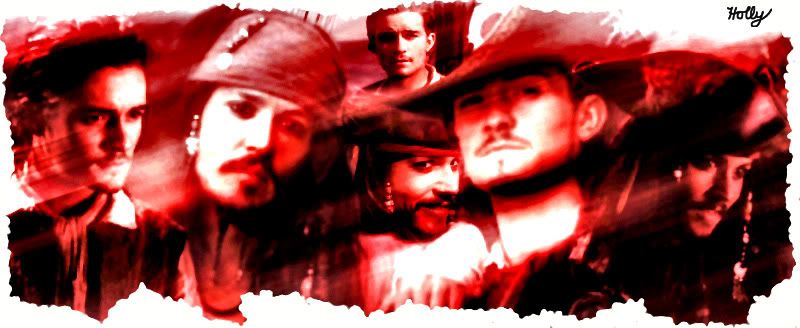
As I participated in these contests I learned how to master Photoshop both by experimenting on my own and following tutorials as design trends went in and out of popularity. I had no qualms about using photographs plucked from pop culture, but when it came to including other graphic elements--brushes, textures, patterns--I would only use what I created myself. Thus, my pop culture based creations still gave me the chance to learn how to create original content. My interest in graphic design bloomed from there.
The "messing around" genre of participation as written about in Hanging Out, Messing Around, and Geeking Out really rings true when I think about this time period in my life. I used popular culture as a way to shape my identity, gain new skills, and integrate into a like-minded community online. I should also mention that I had one school friend who became active on the same message board, and we used this as a way to "hang out" online, as we chatted on AIM about the design challenges.
It would be easy for me to dismiss all the time I spent working on these contests as frivolous fanart--and not very good fanart at that. And until now, I have. But, when Adam Savage described his childhood, it struck me that my maker origins also stem from pop culture and fandom. With my Photoshop knowledge, I became a graphic designer on my high school's newspaper. When I got to college, I did the same. I took my knowledge of graphic design, paired it with what I knew about desktop publishing from working on the high school newspaper, and became the layout editor of both the university's newspaper and literary magazine. In those roles I experimented, honed my skills, and connected with other creative people.
I wanted to be an active member of the fandoms that I belonged to, but that didn't happen for me by discussing--it happened for me by doing. The gateway into my fandoms was also my gateway into making. I think that this is the case for many people who learn a skill consequential to honoring their favorite television show, movie, or musician. Even if the only thing I ever did with my graphic design skills was continue to make fanart, I still couldn't discount the fact that I was making. This is why I have to now agree with Adam Savage, who maintains that making is a way to have a "conversation with the world." Making is making, and if it has meaning to the maker, it is worthwhile.
One concern I do have for making based on pop culture is that, as with most things that are inclusive, it can also be equally exclusionary. I can look at this exhibit of Breaking Bad artwork and be amazed, not just because of the connection with the show but also with the skills of the artists. Will my friends who have never seen the show care? Probably not. The meaning would be lost on them, and they likely wouldn't look beyond the subject matter. Not every creation will be universally liked, and subject matter is one factor in the likability of a piece. Furthermore, if making is for the maker or for their community, this isn't a problem.
I've seen participatory activities based on pop culture in libraries. These programs can engage people in activities they otherwise might not participate in. In a participatory library space, however, would programming based on pop culture limit the audience? I'm not sure. If consuming the media was part of the programming (such as reading a book together followed by an activity), then everyone is equally invited to participate. If there are external factors, such as being a fan of a movie, this would exclude those who haven't seen a movie. Of course, not every activity will be attractive for every patron, but should pop culture be one criteria?
Wednesday, January 29, 2014
A sense of ownership in library spaces
LIBR-287 reflection, week 1
This week's material highlights the impact the physical library setting has on patrons' experiences. The article Libraries Open Doors, Data to Digital Art Displays describes a digital display at Wyoming's Teton County Library. The library patron becomes a collaborator with the display, as each catalog query is the catalyst for a light to glow based on the subject of the search. Each user's effect on the digital artwork is temporary, but the setting of the library is permanently changed. Library patrons stopping and watching the lights are indicative of the success of this project. A solitary action becomes a shared experience. Of course, not all libraries can install such an intricately engineered display. Instead, we can take away the fact that library visitors like to feel that they have an effect on their environment.I'm sure that this is one reason for the success of the Idea Box at the Oak Park Public Library in Illinois, which has patrons essentially create the exhibits with their responses to a given theme. The Idea Box is a constantly changing space, making it attractive even for those who have already been. Monthly, the exhibit changes entirely. Daily, new patrons add to the display. Once a patron adds to the display, they have become a co-creator and may feel that they have a stake in what happens with the display following their contribution.
Knowing how the physical setting effects patrons is particularly important when establishing participatory spaces. In the article Making Room for Innovation, the authors say that
"Libraries tend to be high-polish, monumental environments designed to impress. They’re not spaces that say 'try things.'"
Makerspaces and other participatory areas ask the patron to interact with the library and the library community in ways that often defy their usual actions in a library. A sense of ownership over space is one way to make patrons comfortable in participating in these areas.
Subscribe to:
Posts (Atom)